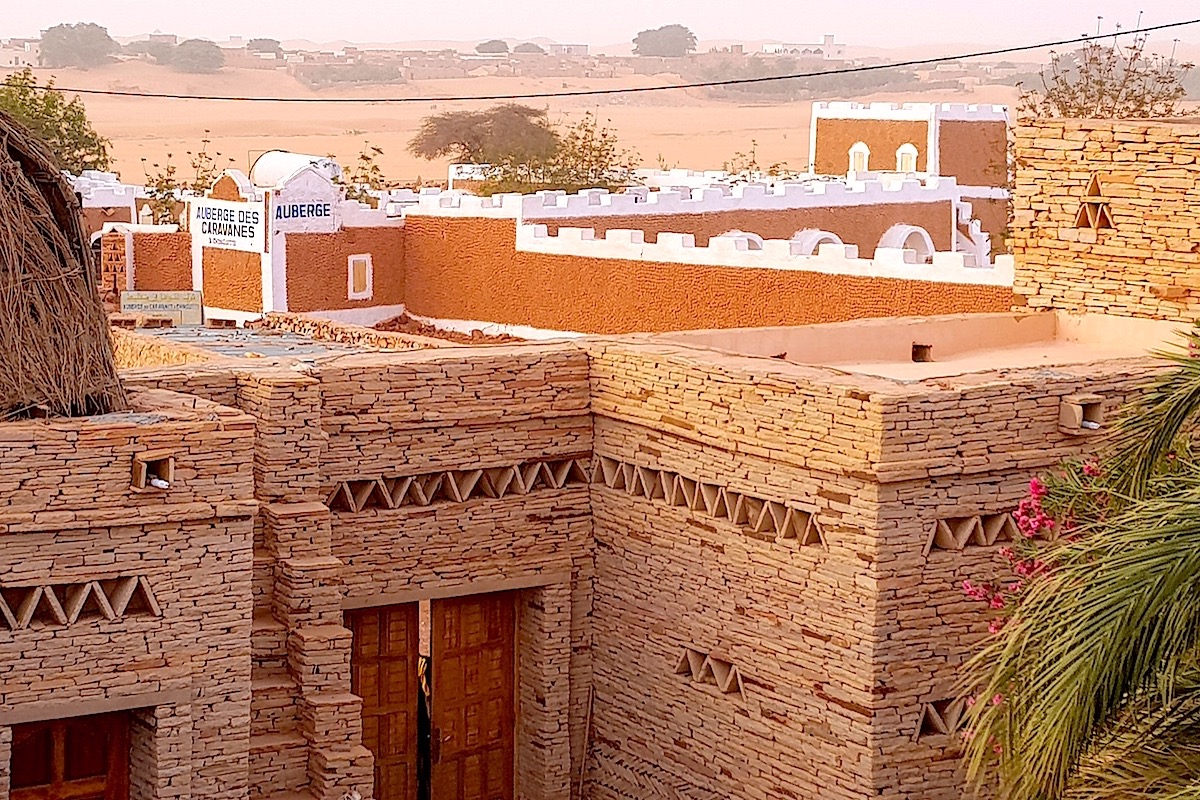
Nouadhibou
Nouadhibou, on the Cap Blanc peninsula, is Mauritania's economic capital. An active fishing port, legendary ship graveyard and departure point for the desert train into the Sahara.
Nouadhibou is Mauritania's economic capital, perched at the tip of the Cap Blanc peninsula between the Atlantic Ocean and Levrier Bay. The country's second-largest city thrives on industrial fishing, iron ore, and a deep-water port among West Africa's busiest. It's also the starting point for the legendary desert train and a gateway to Banc d'Arguin National Park.
Quick facts
- Access: Nouadhibou International Airport (NDB), flights from Nouakchott and select regional destinations.
- Dress code: covered clothing recommended in public spaces, in line with Mauritanian customs.
- Suggested duration: 1 to 2 days in the city; allow longer if combining with Banc d'Arguin or the desert train.
- Currency: Mauritanian ouguiya (MRU); cash essential, few reliable ATMs.
What to see
The city splits between a bustling center around the central market and the port district. The artisanal fishing port offers a lively spectacle: colorful pirogues, fish landings, fish merchants and open-air smoking stations. The mineral port, meanwhile, receives SNIM convoys loaded with iron ore from Zouerate.
Levrier Bay, semi-enclosed and shallow, shelters colonies of Mediterranean monk seals — one of the world's last surviving populations — along with dolphins and numerous seabirds.
History and context
Founded in the late 19th century under Spanish then French administration, Nouadhibou developed around fishing and trans-Saharan trade. Mauritanian independence in 1960 and iron ore exploitation from the 1960s onward transformed the city into an industrial hub. The free trade zone established in the 1990s solidified its role as a regional commercial crossroads.
Highlights of your visit
The desert train
The SNIM convoy connects Nouadhibou to Zouerate over roughly 700 km across the Sahara. It's one of the world's longest freight trains. Travelers can board ore wagons or the rare passenger carriages. Departure is from Nouadhibou station; schedules vary with industrial rotations.
The ship graveyard
Along the northern coast of the peninsula stretches one of the world's largest ship cemeteries. Dozens of rusted wrecks have been beached in shallow waters for decades. The site is accessible by taxi or off-road vehicle from downtown. No tourist infrastructure exists; a visit with a local guide is recommended.
The central market
Nouadhibou's market concentrates fresh fish, spices, textiles and handicrafts. It's the best place to observe daily life and taste local specialties like Mauritanian thieboudiene or grilled fish.
Levrier Bay and Banc d'Arguin
The bay forms a wetland of international importance. The Banc d'Arguin National Park, UNESCO World Heritage listed, is accessible from Nouadhibou by track. It shelters millions of migratory birds and Imraguen fishing communities.
Photography tips
The fishing port is most photogenic early morning when pirogues return. For the ship graveyard, raking late-afternoon light emphasizes rusted textures. Always ask permission before photographing people; avoid photographing military or industrial port installations.
Location and access
Nouadhibou occupies the southern tip of the Cap Blanc peninsula, bordering Western Sahara. The city connects to Nouakchott via an asphalt road roughly 470 km long. The international airport serves a few regional flights. Shared bush taxis depart regularly for the capital. Access to Banc d'Arguin requires a 4×4 vehicle and a guide.
Nearby
- Banc d'Arguin National Park — UNESCO site, sanctuary for migratory birds and monk seals, accessible by track from Nouadhibou.
- Cap Blanc — the peninsula's extreme point, with a monk seal colony and Atlantic cliff scenery.
- Zouerate — mining town in the heart of the Sahara, desert train terminus, roughly 700 km by rail.
Frequently asked questions
November to March offers gentler temperatures (68-82 °F). The Saharan summer (June-September) is very hot and windy. Winter is also ideal for observing migratory birds at Banc d'Arguin.
The site sits on the peninsula's northern coast. A taxi or off-road vehicle from downtown suffices. No official marked access exists; a local guide facilitates the visit and helps avoid private areas.
Yes. The SNIM station is in Nouadhibou. The train runs to Zouerate several times weekly depending on industrial rotations. Schedules are irregular; inquire locally or through your local agency.
Most nationalities require a visa. It's obtainable on arrival at Nouadhibou airport for many passports, but verify conditions according to your nationality before departing.
Yes, it's the typical departure point. The track requires a 4×4 and an experienced guide. Park entry authorization is required; your local agency can arrange this.
Mauritania is a conservative Muslim country. Wear clothing covering shoulders and knees in public spaces. Women traveling alone will find a headscarf helps blend with local customs.
Want to discover this destination?
Our local advisors design your tailor-made trip.