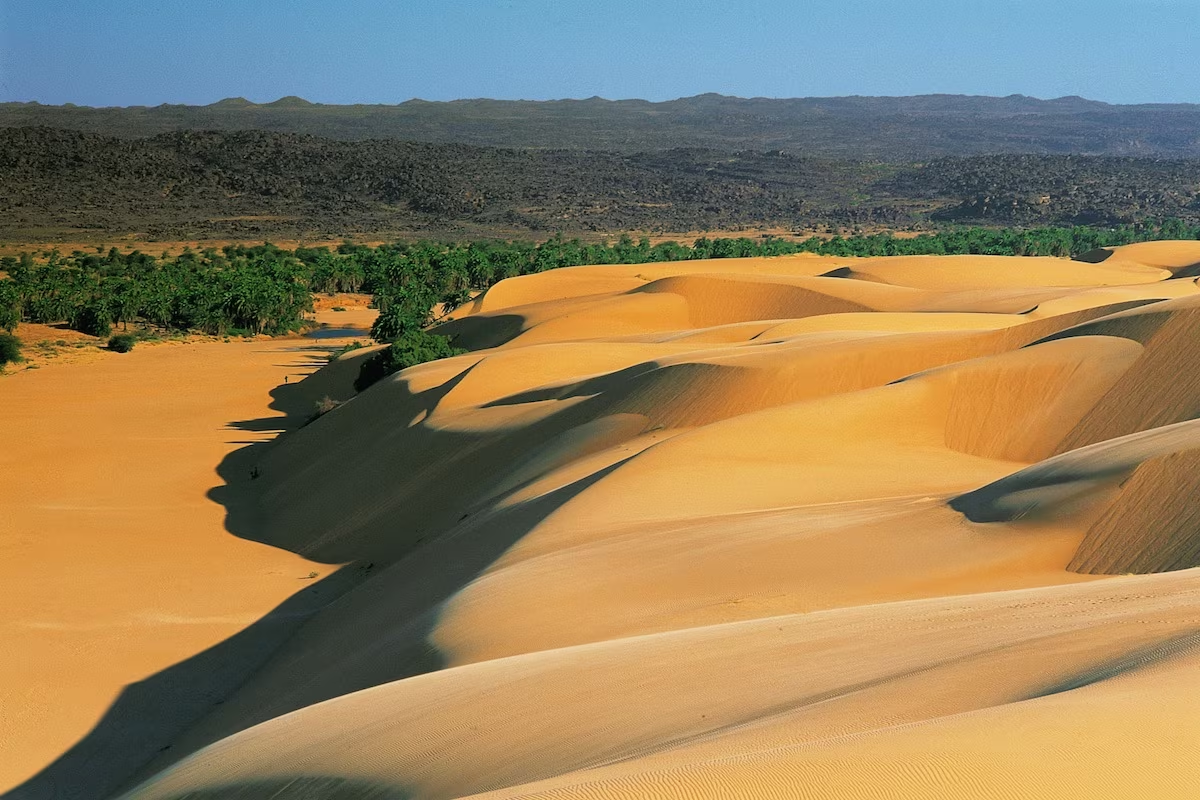
Dunes and Palm Groves - Saharan Mosaic in Western Adrar
On the nomadic trails of the Adrâr, between golden sand dunes and secret palm groves of the Mauritanie Sahara.
Duration
16 days
Ideal seasons
Jan, Feb, Mar, Oct, Nov, Dec
Style
Expeditions
Comfort
rustique
Travelers
Couple, Solo, With friends
The spirit of travel
The western part of the Mauritanian Adrâr offers great landscape diversity.
The plateau is crisscrossed by a dense network of faults of tectonic origin where wadis flow. Here blonde ergs are predominant; they come to rest against raised blades of black sandstone. Erosion, transforming sandstone into sand, has shaped multiple landscapes over millennia. Thus, in the valley floor, the softness of small palm groves stands out from the steep and austere mountain massifs.
A few sedentary cultivators continue their traditional life in this Sahara that can be generous. In the ergs and on the surrounding plateaus, nomads pace their time with long seasonal movements in search of salvation rains. Their white or brown tents are there, sheltered from view, in the terrain's movements. In secret crevices are set guelthas with crystal-clear waters, and wells supplying nomads and caravans.
This journey, dominated by sand, travels through the most beautiful sectors of the Warane erg; it offers one of the most varied panoramas of Saharan atmospheres. The return crosses the palm grove region of the Oued el Abiod.
Of sustained level, this camel trek requires excellent physical and psychological fitness.
Sustained: 5 to 8 hours of hiking per day. Excellent physical condition necessary as stages can be long. You must be capable of maintaining this pace for several days in difficult terrain.
The stages of your journey
Highlights
Day-by-day itinerary

International flight departing from Paris to Nouakchott
Paris Airport → Nouakchott
Indicative flight proposal: Royale Air Maroc.
We depart late in the day for the Mauritanian capital via Casablanca in Morocco. Once formalities are completed, we welcome you in the hall of the Nouakchott airport terminal.
By a short transfer into town, we reach our hotel in the middle of the night for well-deserved rest.

On the way to the Adrâr plateau
After leaving the city and its suburbs, we take the beautiful paved road that heads northeast towards the mining town of Akjoujt.
The Trarza region and the Atlantic coast are now behind us, the vegetation changes and becomes increasingly Saharan.
The vast sandy plains of Inchiri lead us towards the somewhat surreal city of Akjoujt. Mining industry is present there and, since the Chalcolithic, Man has been extracting copper, gold and other materials.
Gradually the landscape changes. You are now driving in the Amsaga region.
In the distance, to the east, the dark barrier of Adrâr begins to take shape. You pass the great alluvial plain of Yagref and the village of Aïn Ahel Taya. The road crosses the first step of the Adrâr.
Continuation towards the ancient city of Chinguetti.
The track to climb onto the plateau (dhar) is, to this day good, but it can be degraded by the rains that occur in late summer.
In the afternoon we take time to visit the old town: library(ies), palm groves and gardens.
The ancient city of Chinguetti
Chinguetti was founded by the Ida Ouali around 1525, upstream from Abweyr, now disappeared, itself created in 1261.
The probable etymology of the toponym shingitî would be:
well of the horse, from Soninké: si: well + n: of + gede: horse.
Chinguetti was the most active commercial center and the most important city of the western Sahara. It was considered by Mauritanians as the 7th holy city of Islam with its 11 mosques, its 100 wells and its circle of scholars.
In 1675, a massacre perpetrated by part of the Ida-ou-Ali led to the breaking up of the group whose survivors founded another ksar in the Tagant, Tidjikja.
Today only a single mosque and the memory of prosperous periods remain…
The main tribes that make up its population are the Ida-ou-Ali, the Laghlal and the Oulad Gheilan.
With their narrow and winding streets, their numerous dead ends, their low and dark houses made of local materials, their near absence of squares and communal spaces, Chinguetti and Wadâne have the structure of old ksour densely huddled around their mosques.

Start of the camel trek, the dunes of the Erg Warane
Chinguetti → Al Gheïla
Getting our caravan started takes a while, as it does for any large caravan.
Heading south. We are making our way towards the small palm grove of Lagueila, nestled between two sand dune cordons of the M'ghalig (large dune massifs).
The itinerary described is given for indicative purposes only as it depends on water sources, pastures, atmospheric conditions or gardens of sedentary populations.
The stages are subject to various influencing factors:
Extent of the rainy season that may have caused flooding, sandstorms or presence of camps near which it is impossible to set up bivouacs, etc.
Al Gheïla → M'Ghalig Warane
Then, heading due west, we continue our journey through the dunes.
Vegetation specific to the great ergs develops such as Acacia raddiana, Balanites aegyptiaca and Aristida pungens.
We set up camp on one of the mighty sand massifs.

Immersion in the sands to reach the rocks of Kider
M'Ghalig Warane → North Kider
Following in the footsteps of the Ida-ou-ali exodus from Chinguetti, who left to found Tidjikja in the medieval period, the caravan crosses the high dunes of the Erg Warane. Wells and pastures allow nomads to traverse these vast sandy expanses. Due south, the edge of the Kider plateau soon comes into view; we make a slight detour to revisit the rock paintings we discovered on a previous journey; pottery shards and flint artifacts confirm the occupation of the site in the Neolithic period. We then head towards the Amoum well. Spectacular landscapes and camp north of the aklé, soft and chaotic dunes, difficult for camels, but very beautiful. The shade of the acacias near the well is welcome.

From plateau to plateau, Kider Amoum Roueissat
North Kider → Amoum
Amoum → Roueissat Massif
Heading south, after crossing the aklé, we traverse the tumuli zone that overlooks the Amoum well. We then head up the Amoum wadi, towards the sandstone massif of Roueïssat. We walk between small sandstone castles, remnants of erosion over millions of years. This rarely visited zone has offered us traces of gazelles on each of our passages. After lunch under a few acacias, we find the dunes that gradually invade the Roueissat plateau. We sleep on the plateau with, on the horizon, the Roueïssat erg, a golden river of aligned dunes.

Walk in the aklé of Roueissat
Roueissat Massif → Erg Roueissat
Vegetation gradually disappears as the dunes become denser; we zigzag across, threading through the interdune corridors, with the high black ridge of the Tanemouj plateau on the horizon.

Oases, Springs and Wells Near Amjenjer Basin
From Erg Roueissat
Hassi Echig → Amjenjer
As we leave the dunes, a small relief shelters a salty spring, attracting numerous birds, both sedentary and migratory, and traces of a procession of predators. We dedicate time to observing life around this surface water point, very rare in the Sahara, since generally water is only accessible with a rope and a waterskin. After crossing a cork of high dunes, we discover the Echig wadi, and its welcome well. On the way to picnic at the foot of the Tenemouj plateau, we discover an old underground storage depot for goods, mainly salt. Then from the heights of this immense plateau, the march towards the bivouac will offer us great moments of emotion above the immense sandy areas. The plateau is rigorously flat, and the gaze is lost on the horizon, impossible to evaluate in terms of distance. It seems to recede before us, and the use of a compass is essential. A passage, which we discover at the last moment, allows us to reach the plain; we overlook the landscape far to the south, and at our feet the wooded valley of Amjenjer hides somewhere our camels and our bivouac.

Aïn Safra Village
Amjenjer → Aïn Es Safra
After crossing the Amjenjer valley and to reach our picnic on the edge of a lovely pond, we cut across the plateau, occupied by pretty orange barchan dunes (crescent-shaped dunes). By the wadi or the plateau we reach the improbable oasis of Aïn Sefra ("The yellow spring"). A handful of huts seem to have been thrown onto the plateau on a windy day, against which they are poorly protected. You only discover the wadi and the cluster of palm trees when you really arrive at the edge of the cliff that overlooks the wadi. We fill our jerrycans and waterskins, while all the children have left school to come and see these funny nomads. We move away from the village to bivouac behind a line of dunes.

The Mysterious Valley of Aït Maoualine
Aïn Es Safra → Ait Maoualine
We now head west and reach the almost enclosed plain of Aït Maoualine; the pastures are generally quite rich, but wild deforestation has caused considerable damage. No one will come to control this illegal activity so far from main roads. Tongues of sand descend and climb the foothills that surround this basin. The most common tree species are Acacias raddiana (Talha), Balanites aegyptiaca (Teichot), Boscia senegalensis (Eizine). Greenery, sand and rock make up a rich and varied landscape.

The Mineral Universe of the Astonishing Toudouchine Palm Grove
Walking tour
We wind through the maze of more or less sandy wadis in this area of highly fractured plateaus. No straight line is possible. We reach one of the wells of Toudouchine, a rallying point for the nomads and semi-nomads of the region. We enter the heart of the territory of the Oulad Sassi; they are part of the tribal confederation of the Ideichili, who have always enjoyed a certain autonomy in relation to the Hassan tribes and emirial authority. They were a source of quasi-permanent contestation against the various successive powers. French penetration into Mauritanie was temporarily destabilized by the death of X. Coppolani (head of the pacification mission in Mauritanie), killed in Tidjikja on May 12, 1905 by an armed band essentially made up of members of the Ideichili tribe. The palm grove of Toudouchine el Kebir welcomes us at lunchtime; we will also spend the night there after a well-deserved afternoon of rest.

The canyons and gueltas of Sbaïa (the lion)
Toudouchine → Gueltas of Sbaïa
Always between wadis and plateaus, but in more open landscapes, we enter a beautiful tectonic fault, sheltering trees and water pools of Sbaïa ("lion's watering holes"); this name refers to this feline, which could still be encountered in the 1930s/40s of the previous century. Despite regular human occupation, we sometimes observe fauna that is very representative of Saharan regions. The golden jackal (Canis aureus) is well represented as well as the fennec (Fennecus zerda) and the pale fox (Vulpes rueppelli). A few spotted hyenas (Crocuta crocuta) occasionally take animals (goats or sheep) from herds. The honey badger (Mellivora capensis) and the porcupine (Hystrix cristata) are also present. Among felids, we were able to observe sand cats (Felis margarita) and in autumn 1998, one or more large felids not really identified, moved throughout the arc of the Adrâr. It could be cheetahs (Acinonyx jubatus), or more likely caracals. Their migrations were tracked thanks to the predation they committed on the herds of donkeys at encampments. It appears they would have tracked the transhumance of the Ideï Boussat nomads from the Hodh towards the north of Mauritanie.

On foot always to reach the beautiful Abteïli valley
Gueltas of Sbaïa → Abteïli
A short stage takes us to the lake (when it has rained) blocked by dunes, in the overflow area downstream from Abteïli. Many unexpected birds are then observable (ducks, waders, …). The mauve cliffs stand out singularly against the dense green of date palms. White sand adds a note of softness to this landscape. The Ideichili nomads have the habit of settling in these areas of the Adrâr during the height of the dry season. As spring approaches, they often resume their migrations toward the southwest, toward the pastures of Bou Nagâ or Timassoumit, to meet the African monsoon. We take our time to reach the bivouac, meeting point with our vehicles, at the foot of beautiful cliffs.

By car through western Adrâr to reach Atar
Abteïli → Atar
Departure by 4x4 towards the north. At midday, we return to the Wadi El Abiod, a vast fissure collecting water from extensive plateaus usually rich in pastures. Many small palm groves benefit from abundant and shallow water. We reach Atar at the end of the day. The guesthouse with simple and pleasant comfort of our correspondent welcomes us for dinner and overnight stay.
The city of Atar founded in the 17th century in the borderland plain (bâten) that stretches north of the great cliff, is preserved from sand by its geographical location.
It is the most important city in the Saharan zone. It was formerly an emirate city a garrison city for the Americans then the French and finally the regional capital.

International flight for return to France
We head west. We leave behind the last plateaus of the Adrar to reach the Yagref depression.
The cones of black rock and the chains of dunes of Amatlich characterize the landscapes of Amsaga.
Then, the vast plains of Inchiri lead us to the Atlantic coast and the capital of Mauritania.
Nouakchott → Paris Airport
Following your flight schedule to France, we transfer you to the Nouakchott-Oumtounsy International Airport.
Practical Information
Registration is considered firm and final after payment of a deposit of 40% of the total price and acceptance of the specific terms of sale.
The balance must be paid no later than 45 days before the departure date.
See our specific terms of sale for full details.
In the event of cancellation by the traveller, the following fees apply:
- More than 60 days before departure: 40% of total price (deposit retained)
- Between 60 and 30 days before departure: 50% of total price
- Less than 30 days before departure: 100% of total price
We strongly recommend taking out cancellation insurance. See our specific terms of sale for full details.
The information below concerns travelers who are nationals of the European Economic Area (EEA), Switzerland, and Canada traveling to Mauritania for a tourist stay. As entry rules may change, we recommend verifying this information with the official authorities before your departure.
Passport
To enter Mauritania, your passport must be valid for a minimum of six months after the date of entry into the country and must have at least one blank page for immigration stamps.
The document must be in good condition (no damaged, torn, or altered pages).
Visa
Nationals of the European Economic Area, Switzerland, and Canada must in principle have a visa to enter Mauritania. This visa can be obtained:
from the embassy or consulate of Mauritania in your country of residence before departure,
or, depending on current conditions, upon arrival at Nouakchott International Airport (visa on arrival), for a stay of up to 30 days.
It is strongly recommended to inquire with the Mauritanian authorities or the competent embassy before departure, as visa application procedures may change.
The authorities may request:
an exit ticket from the territory (return or onward flight),
proof of sufficient financial resources for the duration of your stay,
a hotel reservation or an invitation letter.
Health and vaccinations
No vaccinations are officially mandatory to enter Mauritania, with the exception of the yellow fever vaccine if you are arriving from a country where this disease is endemic.
However, several vaccinations are strongly recommended by health authorities:
Hepatitis A and B
Typhoid
Meningococcal meningitis
Rabies (depending on planned activities)
Update of your routine vaccination schedule (diphtheria, tetanus, poliomyelitis)
Antimalarial prophylaxis is recommended for the entire Mauritanian territory. Consult a doctor or an international vaccination center before your departure.
Security and registration
Mauritanian authorities may require the registration of foreign travelers with local police or gendarmerie services within 48 hours of arrival, particularly outside the capital. It is advisable to inquire about the obligations in place at the time of travel.
Due to the security situation in certain regions of the country, it is recommended to consult travel advice issued by the authorities of your country of residence before departure.
Traveling with children
Minors must hold their own valid passport covering the duration of the stay.
In some European countries, when a minor travels without one of their parents, an exit authorization from the territory may be required according to the regulations of their country of residence.
Other nationalities
Entry conditions may vary depending on nationality. Travelers concerned should inquire with the embassy or consulate of Mauritania in their country of residence.
To participate in our trips, it is strongly advised to be insured for evacuation assistance and medical expenses abroad.
Your local agency encourages you to review the specific policy developed with our partners CHAPKA ASSURANCES and AXA ASSISTANCE.
To subscribe to insurance, learn about coverage and rates, follow the link below.
CAP EXPLORER: The comprehensive insurance solution designed for a worry-free journey!
Choose the plan that suits you best:
Explorer'Multirisque
Explorer'Annulation
Explorer'Assistance
Specific to our trips, we strongly recommend subscribing to one of them.
If you choose to subscribe to one of these plans, the policy detailing all coverage and claims procedures are available on the insurer's website.
Your local agency will be aware of this, but only the participant is responsible for complying with claims reporting procedures. The participant should therefore keep this policy with them throughout their trip.
Chapka — Cap Explorer
Our insurance partnerTravel with peace of mind with our partner Chapka. Cancellation, repatriation, medical expenses, baggage… All the coverage for a worry-free trip.
Travel with peace of mind — I'll handle the insuranceFrequently asked questions
A tourist visa is required and is issued upon arrival at Nouakchott Airport or at the consulate. Your passport must be valid for at least 6 months beyond your entry date. The security situation requires heightened vigilance. Before booking your trip, please check with the consulate or embassy of your destination for entry requirements applicable to your nationality.
Go to the My Trips section to find all your projects.
You can send a message to your host directly from the Tea Lounge.
For a tailor-made quality trip, budget between 180 and 300 euros per day and per person, including accommodation, meals, 4x4 with driver and English-speaking guide. International flights (500-800 euros return) are additional. The desert, the Sahara train and the beaches offer unique experiences.
Your documents are accessible in the Documents tab of your trip.
Absolutely. We adapt each itinerary to travellers' profiles. For families, we prioritise relaxed paces, family-friendly accommodations, fun and educational activities, and comfortable private transfers. Our English-speaking local guides know how to capture children's attention with age-appropriate anecdotes.
It's simple. You exchange with our local team to define your wishes, budget and dates. You receive a detailed itinerary proposal within 48 hours. You adjust every detail together until you reach the perfect version. You confirm and travel with peace of mind. Your local agency remains available 7 days a week throughout your trip.
In case of emergency, contact your local agency immediately.
Payment is generally made in two installments.
Our agency is part of the Nomadays network, registered in France. You benefit from APST (Association Professionnelle de Solidarité du Tourisme) coverage, which protects 100% of your funds. Secure payment, professional insurance, and English-speaking assistance 7 days a week on the ground throughout your stay. Travel insurance (assistance and repatriation, cancellation) is not included: we offer it through our insurance partner and strongly recommend it.

Let's talk about your adventure — Adrar
Coordinator of Mauritania getaways, based in Atar
La Mauritanie est un pays qui se découvre avec respect et patience. Mon rôle est d’aider chaque voyageur à s’en approcher dans les meilleures conditions, avec confiance et curiosité.
— Antsa