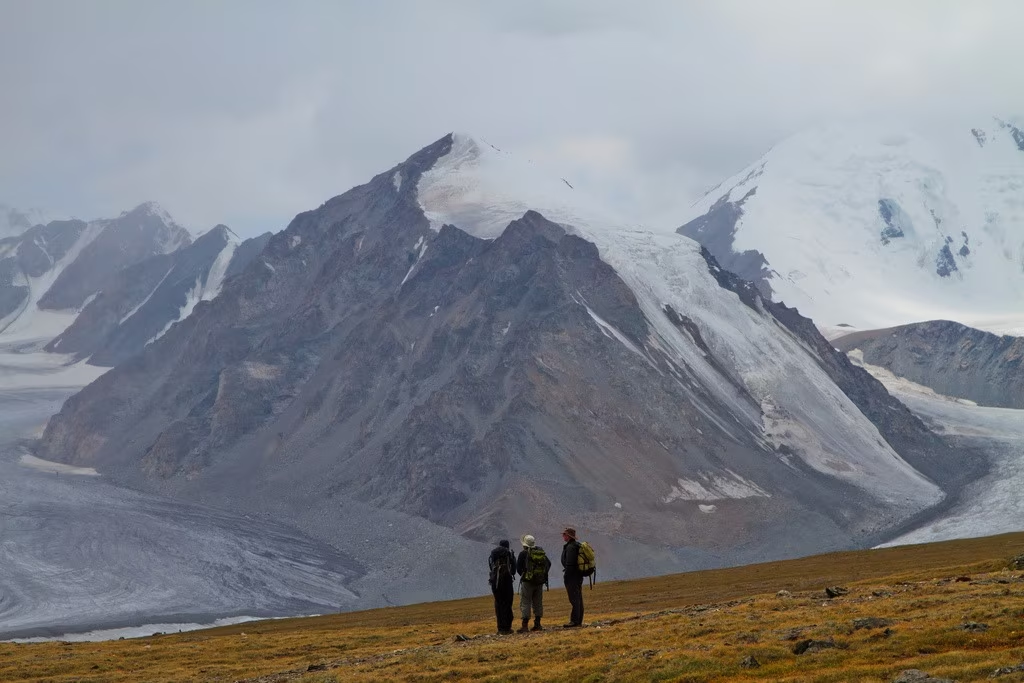
Great crossing of the Adrâr to the Tagant
On the millennial trails of Ida-ou-Ali, a mythical Saharan crossing between golden dunes and secret oases.
Duration
23 days
Ideal seasons
Jan, Feb, Mar, Nov, Dec
Style
Expeditions
Comfort
rustique
Travelers
Solo, With friends, groupe
The spirit of travel
The mythical trek in the footsteps of the Ida-ou-Ali
Departing from Chinguetti, the caravan ventures into the sands of Erg Warâne. Imposing dune massifs follow one after another, sandstone plateaus jagged by erosion, large wadis, forgotten towns and refuge oases. Once past the Khatt depression, we approach the western part of the picturesque Tagant plateau.
In the spirit of great travelers, this long-distance Saharan crossing is a slow transition between the arid lands of a very mineral Sahara and a more hospitable desert.
In this country straddling the Sahara and the Sahel, a crossing can only be conceived along a north-south axis, that of migrations and transhumance.
Moreover, even the reliefs follow this axis since Adrar, Tagant and Assaba form a "vertical" scarf. It is therefore obvious to seek an itinerary connecting the most beautiful Saharan landscapes, but also the least frequented, of the Adrar and Tagant.
We have been traveling this axis for over 20 years, making new discoveries on each journey.
This journey has a challenging difficulty level. By clicking on the link, you will find all the difficulty levels of our journeys.
The stages of your journey
Highlights
Day-by-day itinerary

International flight to Nouakchott
Indicative flight proposal: Royale Air Maroc.
We depart in the late afternoon for the Mauritanian capital via Casablanca in Morocco. Once formalities are completed, we will welcome you in the hall of the Nouakchott airport terminal.
After a short transfer into the city, we reach our hotel in the middle of the night for a well-deserved rest.

Departure towards the Adrar plateau
After leaving the city and its suburbs, we take the beautiful paved road that runs northeast towards the mining town of Akjoujt.
The Trarza region and the Atlantic coast are now behind us, the vegetation changes and becomes increasingly Saharan.
The vast sandy plains of the Inchiri lead us towards the somewhat surreal town of Akjoujt. A mining industry is present there and, since the Chalcolithic, Man has been extracting copper, gold and other materials.
Gradually the landscape changes. You are now driving in the Amsaga region.
In the distance, to the east, the dark barrier of the Adrâr begins to take shape. You pass the great alluvial plain of Yagref and the village of Aïn Ahel Taya. The road crosses the first rise of the Adrâr.
Transfer in 4x4 vehicles to reach the ancient city of Chinguetti (approximately 2 hours of travel).
The track to climb onto the plateau (dhar) is currently in good condition, but it can be degraded by rains that occur at the end of summer.
If we have time, visit to the old town: library(ies), palm groves and gardens. If not, this visit is postponed to the next morning.
The ancient city of Chinguetti
Chinguetti was founded by the Ida Ouali around 1525, upstream from Abweyr, now disappeared, which itself was created in 1261.
The probable etymology of the toponym shingitî would be:
well of the horse, from Soninké: si: well + n: of + gede: horse.
Chinguetti was the most active commercial center and the most important city of the Western Sahara. It was considered by Mauritanians as the 7th holy city of Islam with its 11 mosques, its 100 wells and its circle of scholars.
In 1675, a massacre perpetrated by part of the Ida-ou-Ali led to the splitting of the group, whose survivors founded another ksar in the Tagant, Tidjikja.
Today only a single mosque and the memory of prosperous periods remain…
The main tribes that make up its population are the Ida-ou-Ali, the Laghlal and the Oulad Gheilan.
With their narrow and winding streets, their numerous dead ends, their low and dark houses made of local materials, their near-absence of squares and communal spaces, Chinguetti and Wadâne have the structure of old ksour densely huddled around their mosques.

Chinguettii the gentle, setting up the caravan, straight into the blonde sands of the Erg Warane
Getting our caravan started is a bit lengthy, as is the case for any caravan of significance.
Heading South. We are making our way towards the small palm grove of Lagueila, nestled between two sand ridge corridors of the M'ghalig (large sand massifs).
The itinerary described is given for informational purposes as it remains dependent on water sources, pastures, atmospheric conditions or the gardens of settled communities.
The stages are subject to various influencing factors:
Extent of the rainy season having caused flooding, sandstorms or presence of camps near which it is impossible to set up bivouacs, etc.

Crossing the Erg Warane to reach its South-West edge
Following in the footsteps of the Ida-ou-ali exodus, who left to found Tidjikja, the caravan crosses the Erg Warane by following a major corridor to reach an important well, Hassi Irigui.
We are heading towards the southern edge of the Warane erg. The dunes are softer and progressively we see new dune systems taking shape, the barchan dunes.
As we approach the small Kider plateau, we make a detour to find the rock painting sites that we discovered in the 1990s.
The country is not empty, Mauritania remains a great land of Nomads.
Throughout the journey, especially if grazing is good, we can spot nomadic tents, brown (made of wool and hair) or white (made of canvas), whose edges are rolled up when it is hot or there is no wind.
These nomads are generally welcoming but one can only visit them if one has an important reason to do so. We may perhaps have the opportunity to enter a tent to drink tea (three glasses!) and zrig, fresh or sour milk, mixed with sweetened water.
This is not frequent because, if one knows local customs, one knows that it is not customary to enter a tent when one has not been invited and especially when the nomads encountered are not part of the family of the guide and camel drivers who accompany us.
Herds of camels, she-camels and baby camels are everywhere, as well as goats, sheep, cattle, and donkeys. During the hot season, even if grazing is very green, it is a captivating sight to see all these animals being watered as they patiently await their turn at the wells or at the oglats (groups of wells).
Some years, there is a well between the two massifs. This well has water when nomads are present, otherwise it is silted up.
Our walk goes obliquely westward to reach a new sandstone plateau, Amoum.

The oases of the western part of the Adrâr, between plateaus and sands
The Adrâr is fractured and in the folds of the terrain small palm groves nestle, Aïn es Sefra, Echig El Melah.
We take advantage of these oases to stock up on water. Wadis, plateaus and dune ridges follow one another.
Wide or steep valleys in the mass of the sandstone plateau alternate with rocky coasts and plateaus sometimes invaded by sand.
Pastures, often wooded, alternate with dunes, taken over by vegetation when rainfall has been sufficient.
The Saharan and Sahelian flora is particularly abundant: mrokba (Panicum turgidum), sbot (Aristida pungens), girgir (Schouwia purpurea), el gasba (Tragus racemosus), a grass whose spikelets are equipped with hooked spines, tadaresa (Tribulus), tamachal, akchit, talebat, tigingilit (plant with small red flowers), gourds, as well as another grass, initi or cram-cram (Cenchrus biflorus) whose seeds cling persistently to laces, to the bottom of trousers and to socks!
Trees are numerous, particularly in the valleys: teichot (Balanites aegyptiaca) with powerful thorns, atil (Maerua crassifolia), ifernan (Euphorbia balsamifera) or Fig Tree of Hell, with abundant sap, sder (Ziziphus lotus and mauritania, the jujubes), turjit (Calotropis procera) or Apple of Sodom, not forgetting of course various acacias including talha and tamat. A shrub has particularly fragrant flowers, it is Boscia senegalensis.

The immense dunes of the Tafoujert erg and the far south-west of the Adrar
The Tin Demane plateau offered us gazelle tracks at each of our passages.
Through the imposing Taffoujert dune massif, we reach the south-west edge of the Adrar massif.
Usually caravans do not frequent this erg, given the height of the dunes. Our Amgarij friends demonstrate all their expertise.
Erg Taffoujert → Aouinet Et Tiliski
After a total immersion in the sands, we make a stop at the small palm grove of Aouinet and Tiliski.
Wedged between the sandstone blades of the Tamga massif, the cluster of palm trees is a beautiful discovery, from the highest peak of the massif, the guelb Raoui.

El Khatt Depression and the First Reliefs of Tagant
We leave the Adrar to approach the Tagant; but first we must cross the Khatt plain, the natural boundary of the massifs.
A sentinel standing in this wide depression seems to serve as a link: Telaghza, the blue mountain according to Al Wasit, a former palm grove of the Tadjakant, today abandoned. But it remains an important stopping point for the transhumance of camel herds, as water is near the surface, and many oglat (temporary wells) can be dug.
After setting up our camp, we can climb onto the ridge that overlooks us.
The view of the dunes on the western slope of the mountain and of the small oasis of Taleqza is one of the most beautiful Saharan spectacles we know. The dunes, from white to orange, make the green of the oasis palms stand out in the distance, dominated by an immense slope of sand descending from the ridges.
One never tires of looking! We must unfortunately return to our camp!
Near the mountain, a wide corridor running along the rocks allows us to walk faster.
Crossing the large dunes that isolate us, we advance slowly, although the sand is almost everywhere hard.
The black ridge of the Tagant plateau slowly draws closer. We may reach this evening the cluster of palm trees at Aïn El Khadra (the Green Spring), unless the grazing is sufficient in the dunes.

The Tagant Plateau and the Ancient City of Ksar El Barka
Aïn El Khadra is an important water point in this region.
Lush green grass highlights the proximity of water. As for the spring, it is surrounded by a stone wall to prevent animals from drinking directly from it and falling in.
It is curious to note that the water surface is higher than the surrounding ground. It is rare not to encounter herds of goats, sheep and camels coming to drink there. Through a wide valley we reach the plateau.
The Western Tagant constitutes the lower part of the massif, the area where the floods draining the rocky plateaus of the East and South disappear.
The sandstone is eroded away, leaving here and there rocky formations submerged by sand. The vegetation changes, new trees appear, multicolored birds announce the south.
Neolithic remains and Gangara ruins sometimes crown the rocky hills.
The Tagant is the kingdom of small livestock (sheep and goats), and the population is often semi-sedentary. The chance of pastures causes tents to be set up here and there, often isolated.
Sandy and rocky plateaus alternate, dominated by eroded guelbs, shelters for varied fauna whose traces can be seen everywhere.
Of the old dry stone village of Ksar El Barka, located on the right bank of the wadi El Abiod, only ruins remain.
It was abandoned by the Kounta in 1885, after the last wars with the Ida-Ou-Aïch.
Of a beautiful mosque, only the stone pillars that supported the roof remain.

The dunes, plateaus and green valleys of Tagant
Walking tour
We cross the Inichkane gate to traverse the cirque formed by the Oued El Abiod in the sandstone; through a small tributary and a pass we discover the wadi wedged between sand and rocks of Mraïfig. Night near the water point of Kerked.
Walking tour
By a narrow and delicate path in the middle of the rocks we reach the Biliniar plain.
A new mountain passage gives us access to the Akeneizir wadi, the last sandy landscape of our hiking trip.
We meet our vehicles at the edge of the new paved road Moudjéria – Tidjikja.
Night in the surroundings or at Tamourt n'Naaj, an immense basin where the wadis coming from the higher southern plateaus concentrate.
This wooded basin can become a very extensive lake during summer floods.
Safety day:
As this route is long, we keep a safety day, allowing us to deal with any potential grazing, weather or other problems. The Moudjeria region offers many possibilities to make the most of this day if we don't use it before.

From N'Beïka to the capital of Tagant then the Adrâr
N'Beika, the site is superb!
To the west, the impressive dunes that we will cross by road; to the east, the rocky plateau; in the center, the green Tamourt valley.
We take the time to discover the secret places of this beautiful valley. Moudjéria, located at the foot of the western edge of the plateau. It was founded in 1905 by administrator Coppolani.
We take the paved road that crosses the Tagant massif to reach Tidjikja. We take the time to discover this very specific region.
Wildlife is important in the Tagant, although often nocturnal.
Carnivores: striped hyenas, jackals (whose yelping is often heard during the night), foxes, fennecs, wildcats (Felis sylvestris). Note that the cheetah has only disappeared since the 1960s or 70s.
Rodents: hares, squirrels, gundis, jerboas and gerbils. Also note their neighbors the hyraxes.
Various animals: porcupines (Hystrix cristata), hedgehogs, monkeys (patas and baboons).
Gazelles are rare as they are decimated by hunting. Their tracks can be spotted from time to time (dune and plateau region of the Er Roueissat sector).
Reptiles: various snakes (Moïla, Schockari), vipers (Vipera cerastes, sand viper and Cerastes cerastes, horned viper), various reptiles including numerous dobs (Uromastix), agamas and monitors.
Scorpions can be frequent, especially during warm periods.
Birds are relatively abundant: ravens, falcons, owls, doves, bee-eaters, as well as a large number of European or African passerines, often with very colorful plumage.
Certain gueltas shelter fish such as Clarias or catfish.
A few, more significant ones, such as the one at Matmata near N'Beika, in the south-west of the Tagant, still hide some crocodiles.
Return to Nouakchott then direct flight to Paris
We head west. We leave the last plateaus of the Adrâr to reach the Yagref basin.
The cones of black rocks, the dune ridges of the Amatlich mark the landscapes of the Amsaga.
Then, the vast plains of the Inchiri lead us to the Atlantic coast and the capital of Mauritanie.
A dinner and a room will be at your disposal for a Day Use in Nouakchott from 2:00 PM to freshen up and prepare your luggage.
According to your flight schedule to France, we transfer you to the Nouakchott-Oumtounsy International Airport.
Price per person
This trip can be tailored to your preferences
This itinerary provides an excellent foundation for discovery, but it can be fully customized. Our local advisors build each trip tailored to your budget, dates and preferences.
Not included
- International Flight Paris - Nouakchott - Paris
- Visa fees upon entry to Mauritanian territory
- Personal expenses, beverages
- Tips at your discretion
- Cancellation insurance, emergency medical expenses, repatriation
Included
- Welcome and assistance at Nouakchott airport
- Transfer then transport in 4x4 vehicle on D2, D20 to D23
- Refueling
- Camel team for assistance during the trek
- The care and support of drivers and a cook
- English-speaking Mauritanian guide trained and experienced in our trips
- All camping, cooking and logistics equipment (except sleeping bag)
- Full board throughout your trip to Mauritanie
- Jeloua Guest House in Nouakchott on a double room basis, (subject to availability)
- Guesthouse in Chinguetti on double or twin room basis (subject to availability)
- Inn in Atar on a double or twin room basis (subject to availability)
- Entries into houses with manuscripts in Chinguetti
Practical Information
Registration is considered firm and final after payment of a deposit of 30% of the total price and acceptance of the specific terms of sale.
The balance must be paid no later than 45 days before the departure date.
See our specific terms of sale for full details.
In the event of cancellation by the traveller, the following fees apply:
- More than 60 days before departure: 40% of total price (deposit retained)
- Between 60 and 30 days before departure: 50% of total price
- Less than 30 days before departure: 100% of total price
We strongly recommend taking out cancellation insurance. See our specific terms of sale for full details.
The information below concerns travelers who are nationals of the European Economic Area (EEA), Switzerland, and Canada traveling to Mauritania for a tourist stay. As entry rules may change, we recommend verifying this information with the official authorities before your departure.
Passport
To enter Mauritania, your passport must be valid for a minimum of six months after the date of entry into the country and must have at least one blank page for immigration stamps.
The document must be in good condition (no damaged, torn, or altered pages).
Visa
Nationals of the European Economic Area, Switzerland, and Canada must in principle have a visa to enter Mauritania. This visa can be obtained:
from the embassy or consulate of Mauritania in your country of residence before departure,
or, depending on current conditions, upon arrival at Nouakchott International Airport (visa on arrival), for a stay of up to 30 days.
It is strongly recommended to inquire with the Mauritanian authorities or the competent embassy before departure, as visa application procedures may change.
The authorities may request:
an exit ticket from the territory (return or onward flight),
proof of sufficient financial resources for the duration of your stay,
a hotel reservation or an invitation letter.
Health and vaccinations
No vaccinations are officially mandatory to enter Mauritania, with the exception of the yellow fever vaccine if you are arriving from a country where this disease is endemic.
However, several vaccinations are strongly recommended by health authorities:
Hepatitis A and B
Typhoid
Meningococcal meningitis
Rabies (depending on planned activities)
Update of your routine vaccination schedule (diphtheria, tetanus, poliomyelitis)
Antimalarial prophylaxis is recommended for the entire Mauritanian territory. Consult a doctor or an international vaccination center before your departure.
Security and registration
Mauritanian authorities may require the registration of foreign travelers with local police or gendarmerie services within 48 hours of arrival, particularly outside the capital. It is advisable to inquire about the obligations in place at the time of travel.
Due to the security situation in certain regions of the country, it is recommended to consult travel advice issued by the authorities of your country of residence before departure.
Traveling with children
Minors must hold their own valid passport covering the duration of the stay.
In some European countries, when a minor travels without one of their parents, an exit authorization from the territory may be required according to the regulations of their country of residence.
Other nationalities
Entry conditions may vary depending on nationality. Travelers concerned should inquire with the embassy or consulate of Mauritania in their country of residence.
To participate in our trips, it is strongly advised to be insured for evacuation assistance and medical expenses abroad.
Your local agency encourages you to review the specific policy developed with our partners CHAPKA ASSURANCES and AXA ASSISTANCE.
To subscribe to insurance, learn about coverage and rates, follow the link below.
CAP EXPLORER: The comprehensive insurance solution designed for a worry-free journey!
Choose the plan that suits you best:
Explorer'Multirisque
Explorer'Annulation
Explorer'Assistance
Explorer' Complémentaire Carte Bancaire
Specific to our trips, we strongly recommend subscribing to one of them.
If you choose to subscribe to one of these plans, the policy detailing all coverage and claims procedures are available on the insurer's website.
Your local agency will be aware of this, but only the participant is responsible for complying with claims reporting procedures. The participant should therefore keep this policy with them throughout their trip.
Chapka — Cap Explorer
Our insurance partnerTravel with peace of mind with our partner Chapka. Cancellation, repatriation, medical expenses, baggage… All the coverage for a worry-free trip.
Travel with peace of mind — I'll handle the insuranceFrequently asked questions
A tourist visa is required and is issued upon arrival at Nouakchott Airport or at the consulate. Your passport must be valid for at least 6 months beyond your entry date. The security situation requires heightened vigilance. Before booking your trip, please check with the consulate or embassy of your destination for entry requirements applicable to your nationality.
Go to the My Trips section to find all your projects.
You can send a message to your host directly from the Tea Lounge.
For a tailor-made quality trip, budget between 180 and 300 euros per day and per person, including accommodation, meals, 4x4 with driver and English-speaking guide. International flights (500-800 euros return) are additional. The desert, the Sahara train and the beaches offer unique experiences.
Your documents are accessible in the Documents tab of your trip.
Absolutely. We adapt each itinerary to travellers' profiles. For families, we prioritise relaxed paces, family-friendly accommodations, fun and educational activities, and comfortable private transfers. Our English-speaking local guides know how to capture children's attention with age-appropriate anecdotes.
It's simple. You exchange with our local team to define your wishes, budget and dates. You receive a detailed itinerary proposal within 48 hours. You adjust every detail together until you reach the perfect version. You confirm and travel with peace of mind. Your local agency remains available 7 days a week throughout your trip.
In case of emergency, contact your local agency immediately.
Payment is generally made in two installments.
Our agency is part of the Nomadays network, registered in France. You benefit from APST (Association Professionnelle de Solidarité du Tourisme) coverage, which protects 100% of your funds. Secure payment, repatriation insurance included, and English-speaking assistance 24/7 on the ground throughout your stay.
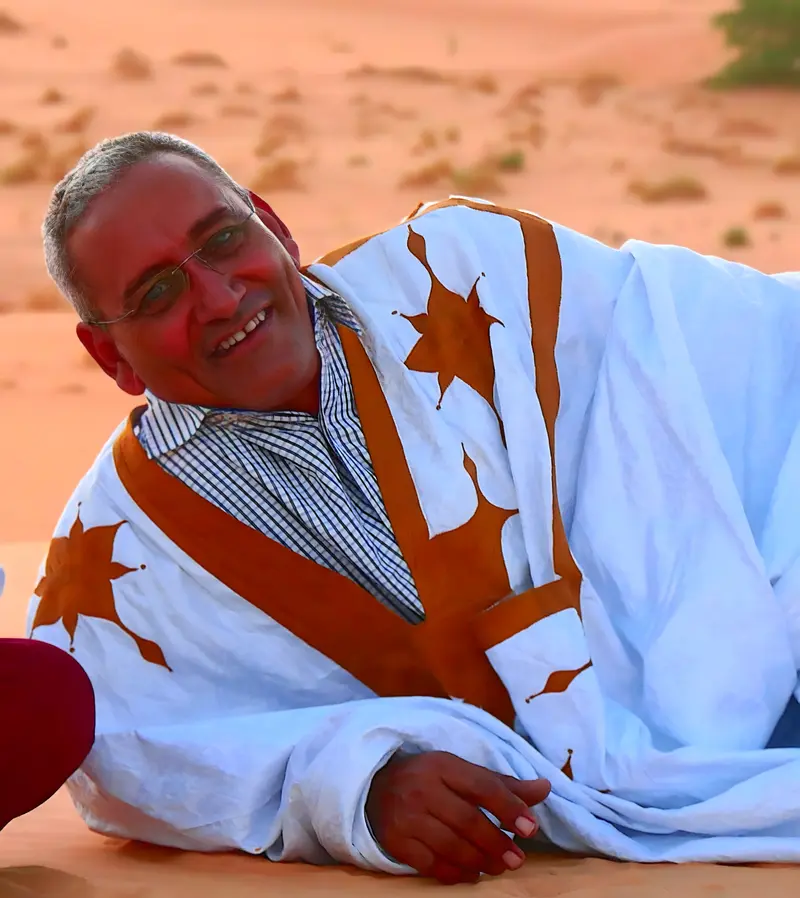
Let's talk about your adventure — Adrar
Craftsperson of journeys in the heart of Mauritania, based in Atar
Mauritania is a country that reveals itself with respect and patience. My role is to help each traveler approach it in the best conditions, with confidence and curiosity.
— Isselmou