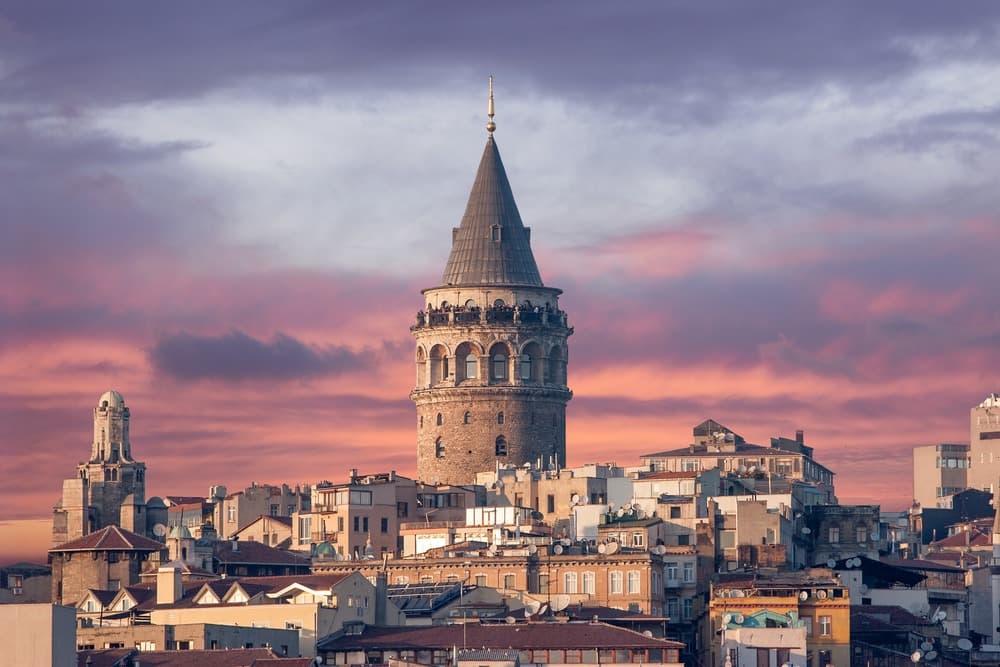
Galata Tower
Galata Tower
Built by the Genoese in 1348, Galata Tower offers a 360° panorama over Istanbul, the Bosphorus and the Golden Horn. An unmissable architectural and historical landmark in the Beyoğlu district.
Galata Tower has dominated the Beyoğlu district since the 14th century. This cylindrical stone tower, standing approximately 67 metres tall, offers a 360° panorama over the Golden Horn, the Bosphorus and the rooftops of Istanbul. Built by the Genoese, it has endured through the centuries serving different functions — prison, astronomical observatory, fire-watch post — before becoming one of the city's most visited vantage points.
Practical information at a glance
- Entrance : paid admission (state museum rate, reduced with Museum Card)
- Recommended duration : 45 minutes to 1 hour
- Access : M2 metro line, Şişhane station; T1 tram, Karaköy station then walk uphill or historic Tünel funicular
- Dress code : no dress restrictions
- Accessibility : internal lift available up to the panoramic gallery
What to see
The narrow, breezy exterior gallery wraps completely around the tower. On clear days, the view extends to the Prince Islands in the south and Asian hills to the east. Below, the Karaköy district and Galata Bridge structure the vista over the Golden Horn. Inside, an exhibition traces the tower's history and that of the Genoese colony.
History and context
The Genoese erected the tower in 1348 under the name Christea Turris (Tower of Christ), to mark the northern boundary of their Galata colony. Following the Ottoman conquest of 1453, it served as a prison and then as an observatory: in the 17th century, Hezarfen Ahmed Çelebi allegedly launched himself from its summit with artificial wings to cross the Bosphorus, according to legend. It was later converted into a fire-watch tower, a role it retained until the 19th century.
Highlights of the visit
The exterior panoramic gallery
The 360° circular balcony remains the centrepiece of any visit. Sunset, when golden light strikes the dome of Hagia Sophia and the minarets, is particularly striking. Arrive early to avoid crowds on the narrow corridor.
Views across two continents
From the gallery, Europe and Asia are visible simultaneously, separated by the Bosphorus. This is one of the rare spots in the city where this geographic duality can be grasped in a single glance.
The Galata district below
The square surrounding the tower is perpetually animated. The steep streets descending toward Karaköy are home to luthiers, art galleries and cafés — a natural walk before or after climbing the tower.
Photography tips
- Best light : golden hour in the evening, facing southeast toward Hagia Sophia and the Blue Mosque.
- Exterior angle : from the square below, a wide-angle lens captures the entire tower with the Galata rooftops.
- Panoramic gallery : the balcony is narrow; a standard lens (35-50 mm) works better than a telephoto.
- Restrictions : no known photography restrictions inside or on the gallery.
Location and access
The tower stands on Galata hill, in the Beyoğlu district, on the European shore. M2 metro (Şişhane station) drops you a two-minute walk away. The T1 tram (Karaköy station) requires a ten-minute climb through cobbled streets. The historic Tünel funicular connects Karaköy to Tünel Meydanı, a five-minute walk from the tower. Hagia Sophia and the Blue Mosque are accessible by T1 tram from Karaköy.
Nearby attractions
- Galata Bridge — a ten-minute walk downhill toward the Golden Horn, animated by fishermen and seafood restaurants.
- Istiklal Caddesi — Beyoğlu's main pedestrian avenue starts from Tünel Meydanı, five minutes from the tower.
- Hagia Sophia — across the Golden Horn in the Sultanahmet district, accessible by tram.
- Grand Bazaar — historic covered market, accessible by T1 tram from Karaköy.
- Pera Museum — art museum in Beyoğlu, a ten-minute walk along Istiklal.
Frequently asked questions
During high season (April–October), queues can be long. Check whether online ticketing is available on the Turkish museums' official website to avoid waiting on-site.
Yes, the Museum Card (Müzekart) grants entry to Galata Tower and many Turkish state museums. It pays for itself after visiting two or three sites.
Spring (April–May) and autumn (September–October) typically offer clear skies and pleasant temperatures. Summer is very crowded; arrive at opening time to avoid congestion on the exterior gallery.
A lift serves the panoramic gallery. The exterior balcony is narrow and may be difficult to navigate in a wheelchair; ask staff on-site for advice.
Yes. From Karaköy, the T1 tram reaches Sultanahmet in a few stops. Allow half a day for both sites, longer if you wish to explore the Galata district.
No photography restrictions are reported inside or on the exterior gallery. Tripods may be difficult to use on the narrow balcony.
Photos
Interested in this visit?
We can include it in your personalised itinerary.