From Banc d'Arguin to the Ends of Mauritanian Adrâr
Between the Atlantic Ocean and the deep Sahara, the Mauritanian adventure reveals its hidden treasures.
Duration
15 days
Ideal seasons
Jan, Feb, Mar, Oct, Nov, Dec
Style
Guided tour
Comfort
rustique
Travelers
Solo, With friends, Couple
The spirit of travel
From the beaches of the Atlantic Ocean to the heart of the Mauritanian desert
This journey takes you through a succession of landscapes, places and encounters, all fascinating.
The Imragens of Banc d'Arguin, nomadic fishermen between land and sea, are the connection between these two paradoxically complementary elements that shape Mauritanian identity.
The railway line guides the traveler to the deep Sahara, to austere yet captivating frontiers.
El Beyyed, Guelb Er Richât, Wadâne are places associated with Men, History and legend. These singular names will resonate long in our travelers' memories.
Throughout our journey, the nomadic world is present everywhere. It captivates us with its quest for the essential, its economical mastery in keeping with the complexity of life in the deserts.
This journey has an easy level of difficulty. By clicking on the link, you will find all the difficulty levels of our journeys.
The stages of your journey
Highlights
Day-by-day itinerary

International flight to Nouakchott
Indicative flight proposal: Royale Air Maroc.
We depart in the late afternoon for the Mauritanian capital via Casablanca in Morocco. Once formalities are completed, we welcome you in the hall of the Nouakchott airport terminal.
By a short transfer into the city, we reach our hotel in the middle of the night for well-deserved rest.

The Atlantic Ocean and Banc d'Arguin National Park
Early in the morning, we head south. If the tide permits, we drive along the Atlantic coast on the beach.
Here, the desert and the sea blend together. The Sahara ends its course pushed by the Trade Winds into this ocean with cold currents.
We reach the Mauritanian capital in the mid-afternoon.

In Canary boat, through the channels and islands of Banc d'Arguin
Early in the morning, we board the Canarian lanches used by Imragen fishermen to move silently through the channels between the islands.
The exceptional richness of Banc d'Arguin is made up of its very important avifauna. Myriads of birds take flight at our approach, forming incredibly beautiful movements in the sky. Marine mammals are also present. It is not uncommon to see dolphins and, with a lot of luck, killer whales.

Towards the north in the direction of Nouadhibou
We drive through a vast flat plain. We remain alert as the world's longest mineral train can pass in either direction. After a few hours on a sandy track, we reach Ben Amira.

The railway and the domes of Ben Amira
We drive through a vast flat plain. We remain alert because the world's longest mineral train can pass in either direction. After a few hours on sandy tracks, we reach Ben Amira.
The Ben Amira monolith is one of the most breathtaking places in Mauritania. The enormous mass of granite rock rises over 600m.
With the sand dunes surrounding it, it provides an excellent Saharan landscape. Ben Amira is the largest monolith in Africa and the third largest in the world, after Uluru and Mount Augustus located in Australia.

Atar, the capital of the Adrâr in Mauritania

From the Sebkha of Chemchan to the Circus of El Beyyed
Departing from the city of Atar, we cross a curious plateau of blue-tinted rocks with strange shapes. These stromatolites, that's their name, bear the trace of the oldest living organisms and organizations12 they are not the remains of a particular organism, but the fossilization of a non-coral reef.
We drive below the cliff of the Adrâr in what we call in Mauritania, the baten - the belly. The dhar is the name of the cliff that looms above us.
In this immense corridor, the great sebkha of Chemchan guides us toward the very beautiful Aderg massif isolated in the dunes of the erg Maghteir.
We continue our journey by passing the cape of Tazazmout then we reach El Beyyed.

Between the Sands and the Adrâr Cliff
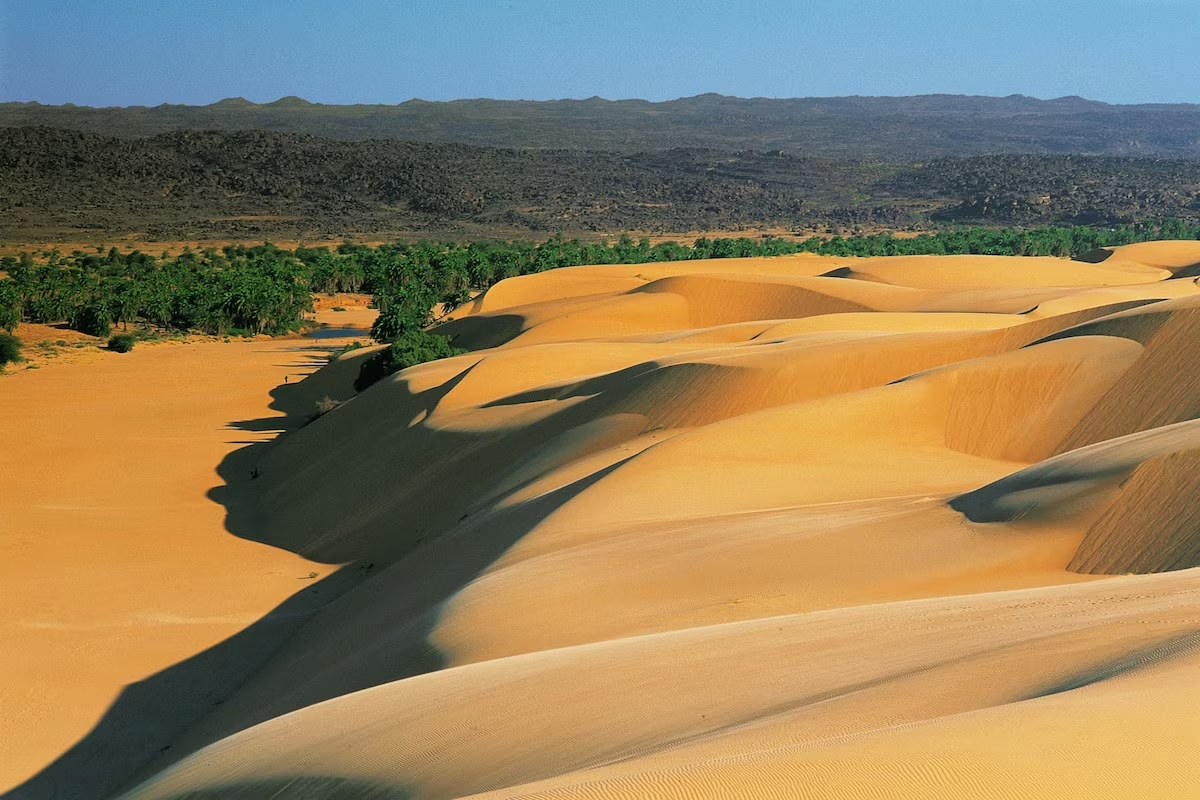
On foot, we set off to explore this iconic Saharan site. To the north, the great dunes of the erg Maghteir stretch out while a natural amphitheater of cliffs surrounds us.
The El Beyyed corridor presents, over nearly 20km towards El Ghallaouiyya, a considerable quantity of lithic material. The region offers some of the main biface and worked pebble sites in western Sahara. The multiple rock art sites here represent samples of so-called "Ethiopian" fauna such as giraffes, elephants, rhinoceroses... This fauna is believed to have disappeared from the area approximately 10,000 to 12,000 years ago. El Beyyed is located at the foot of the great dhar of the Adrâr and, to the north, develops an immense and powerful erg: the Maghteïr.

The Adrâr and the Amazing Guelb Er Rîchat
El Beyyed → Guelb Er Rîchat (Camp Boisé)
Via a very rough track, we climb onto the eastern Adrâr plateau. A detour to the west allows us to admire one of the most beautiful rock art sites of the Adrâr at the head of Ouan an Amourt. Hundreds of engraved bovines… and, with some luck… a watch hanging from the branch of a small acacia…
The Azilal plateau was in the past a large hunting territory for gazelles, even addax which are now completely disappeared.
The Taguenze button opens onto the Guelb Er Richat and after crossing this great rocky reg, we reach the first domes of the Richat.
The flattened dome of Guelb Er Richât, which appears during the secondary period, is located at the borders of the dark mountains of the Adrâr mauritanien, to the west, and the vast expanses of stones, rocky slabs and dunes of the Taoudenni basin, to the east.
The strange system of concentric ridges of the Richât is so impressive that it now appears on all maps, even on small scales.
Richât is the plural of richa (feather), a term that perfectly describes the appearance of its ridges whose leeward flanks are striped with tongues of sand and which dominate the deep plains where goats and camels graze… when, by chance, it has rained.
Because of its very size, it was only revealed quite late, by professor Théodore Monod in 1934.
Indeed, no one, whether coming from the rugged plateaus of the north or the dunes of the Majabat Al Koubra (Monod, 1958), to the south and south-east, could imagine that these low ridges are organized into such a perfect concentric system, vaguely elliptical of 22 km and 25 km in diameter, emerging from a window of 45 km, the Taguenzé, open in the sandstone plateau.

From the Heart of the Phenomenon to the City of Knowledge and Wealth
We leave the various circles of Richat heading south, towards Hassi Thiba and the traces of the ancient Portuguese fort of Aguadir. Saharan forests are relatively developed in this area. As we plunge towards the sands, the palm groves of Meyateg survive with difficulty.
We reach Wadane and the very beautiful valley of Tin Labbe.

Discovering Wadâne and Its Surroundings
The ksar of Wadâne, (Ouadâne) which was founded, it is said, the same year as Tichîtt (1141), derives its name from the Arabic word meaning "two riverbeds" (wadân). The details according to which these two wadis would be the wadi of dates and the wadi of sciences are a great credit to the city.
The ancient city is mentioned in writing in the middle of the 15th century in a Portuguese travel report, but it remains difficult to get a precise idea of the city's beginnings despite its position on the western axis of trans-Saharan caravan trade.
Wadâne is a dense urban center, of the ksar type, formerly surrounded by a very secure fortified enclosure that resisted all foreign forces until the arrival of the French.
The dominant tribes are the Kounta, the Ida or El Hadj, the Chorfa, the Amgârîj and the Aghzazir.

The Tanouchert oasis and the El Kheouiya semi-nomadic camp
We now skirt the erg Warane which runs along the Adrâr plateau from the eastern confines. It marks the boundary that is difficult to cross by car of the immense empty space, the Majabat Al Koubra.
The Tanouchert palm grove nestled in its dune setting has crossed the centuries while maintaining a certain lustre.
To the west, the mega sandstone ridge of Herour winds its way through the heart of the dunes. Like the Zarga massif, Herour has a fascinating geomorphological history.
We reach the El Kheouiya semi-nomadic camp. Established on the banks of a major wadi, our hosts have left their mark on our history.
The semi-nomadic camp of El Kheouiya is settled there during major droughts. The camp, for a few years now, has been organizing itself: development of goat and camelid breeding (from 2 camels in 1993, now a herd of over 70 animals), creation of a school in 1994, birth of a small palm grove associated with gardens in 1999 and, now, a few solid structures.
"But we, we remain under the tent" Atfeil, the camp leader, assures us…
The bonds we maintain with the different families of the camp are close and greatly friendly.

Chinguetti, at the edge of the Warane erg
Through the sands, heading due west, we set our course for the ancient caravan city of Chinguetti. The Chinguetti wadi, downstream from the city, is covered with trees, and life is intense there. We pass through the city for lunch. Unfortunately, uncontrolled and unplanned urbanization has damaged the city's traditional character.
Chinguetti was founded by the Ida Ouali around 1525, upstream from Abweyr, which has now disappeared and was itself created in 1261.
The probable etymology of the toponym shingitî would be: well of the horse, from Soninké: si: well + n: of + gede: horse.
Chinguetti was the most active commercial center and the most important city in the Western Sahara. It was considered by Mauritanians as the 7th holy city of Islam with its 11 mosques, its 100 wells and its circle of scholars.
In 1675, a massacre perpetrated by part of the Ida-ou-Ali led to the breakup of the group whose survivors founded another ksar in the Tagant: Tidjikja.
Today only one mosque remains and the memory of prosperous periods…
The main tribes that make up its population are the Ida-ou-Ali, the Laghlal and the Oulad Gheilan.
With their narrow and winding streets, their numerous dead ends, their low and dark houses made of local materials, their almost complete absence of squares and communal spaces, Chinguetti and Wadâne have the structure of old ksour densely huddled around their mosques.

The Western Adrâr, Between Gorges and Palm Groves
Through the soft sand of Wadi Chinguetti we reach the western tongue of the Warane erg. A few barchan dunes are now developing on the sandstone plateau.
The mega-ridge of Zarga blocks our path and raises its eroded rocks submerged in the sands.
An ice deposit warehouse in Adrâr!
Thesmall mountain of Zarga is an esker about a hundred meters high and approximately 50 kilometers long.
It is the result of an incredible geomorphological adventure dating back to the dawn of time, 440 million years ago (late Ordovician).
Today, the mega-fossil ridge of Zarga marks the western end of the Warane erg. It blocks the flow of sands coming from the confines of the Chech erg.
Thwarted by this natural barrier, the Warane erg then changes name to become the Amatlich, then the Akchar before disappearing into the waters of the Atlantic Ocean.

The vast plains of Inchiri and the capital, Nouakchott
The track climbs the plateau and then, after a few kilometers, we reach the paved road. This road axis links the Adrâr region to the Tagant region and its capital Tidjikja.
A nice descent allows us to access the Tergit oasis.
We head west. We leave the last plateaus of the Adrâr to reach the Yagref basin.
The cones of black rocks, the cordons of dunes of the Amatlich mark the landscapes of the Amsaga.
Then, the vast plains of the Inchiri take us to the Atlantic coast and the capital of Mauritanie.
A dinner and a room will be at your disposal at the Jeloua Guesthouse to refresh yourself and prepare your luggage.
Transfer to the airport and flight to Paris.
Price per person
This trip can be tailored to your preferences
This itinerary provides an excellent foundation for discovery, but it can be fully customized. Our local advisors build each trip tailored to your budget, dates and preferences.
Not included
- International Flight Paris - Nouakchott - Paris
- Entries and/or taxes not included in the programme,
- E-visa fees upon entry to Mauritanian territory,
- Personal expenses, beverages,
- Tips at your convenience,
- Cancellation insurance, first aid costs, repatriation.
Included
- Reception and assistance at Nouakchott International Airport,
- Transfer and 4x4 vehicle rental (fuel included) suitable for this type of trip - 6 to 7 travelers: 3 vehicles, 8 travelers: 4 vehicles
- Drivers with full service
- Cook from 5 participants,
- English-speaking local guide trained and informed about our trips,
- All camping equipment, cooking and supply materials,
- Full board throughout the trip in Mauritania,
- Entry into houses with manuscripts in Chinguetti,
- Jeloua Guesthouse in Nouakchott on a double room basis, (subject to availability),
- Horel Cansado in Nouadhibou on a double room basis, (subject to availability),
- Guesthouse in Azougui, in a double room (subject to availability),
- Tinlabbe Guesthouse in Wadâne, in a double room (subject to availability),
- Inn in Chinguetti on a double room basis, (subject to availability),
- Boat navigation at Iwik,
Practical Information
Registration is considered firm and final after payment of a deposit of 30% of the total price and acceptance of the specific terms of sale.
The balance must be paid no later than 45 days before the departure date.
See our specific terms of sale for full details.
In the event of cancellation by the traveller, the following fees apply:
- More than 60 days before departure: 40% of total price (deposit retained)
- Between 60 and 30 days before departure: 50% of total price
- Less than 30 days before departure: 100% of total price
We strongly recommend taking out cancellation insurance. See our specific terms of sale for full details.
The information below concerns travelers who are nationals of the European Economic Area (EEA), Switzerland, and Canada traveling to Mauritania for a tourist stay. As entry rules may change, we recommend verifying this information with the official authorities before your departure.
Passport
To enter Mauritania, your passport must be valid for a minimum of six months after the date of entry into the country and must have at least one blank page for immigration stamps.
The document must be in good condition (no damaged, torn, or altered pages).
Visa
Nationals of the European Economic Area, Switzerland, and Canada must in principle have a visa to enter Mauritania. This visa can be obtained:
from the embassy or consulate of Mauritania in your country of residence before departure,
or, depending on current conditions, upon arrival at Nouakchott International Airport (visa on arrival), for a stay of up to 30 days.
It is strongly recommended to inquire with the Mauritanian authorities or the competent embassy before departure, as visa application procedures may change.
The authorities may request:
an exit ticket from the territory (return or onward flight),
proof of sufficient financial resources for the duration of your stay,
a hotel reservation or an invitation letter.
Health and vaccinations
No vaccinations are officially mandatory to enter Mauritania, with the exception of the yellow fever vaccine if you are arriving from a country where this disease is endemic.
However, several vaccinations are strongly recommended by health authorities:
Hepatitis A and B
Typhoid
Meningococcal meningitis
Rabies (depending on planned activities)
Update of your routine vaccination schedule (diphtheria, tetanus, poliomyelitis)
Antimalarial prophylaxis is recommended for the entire Mauritanian territory. Consult a doctor or an international vaccination center before your departure.
Security and registration
Mauritanian authorities may require the registration of foreign travelers with local police or gendarmerie services within 48 hours of arrival, particularly outside the capital. It is advisable to inquire about the obligations in place at the time of travel.
Due to the security situation in certain regions of the country, it is recommended to consult travel advice issued by the authorities of your country of residence before departure.
Traveling with children
Minors must hold their own valid passport covering the duration of the stay.
In some European countries, when a minor travels without one of their parents, an exit authorization from the territory may be required according to the regulations of their country of residence.
Other nationalities
Entry conditions may vary depending on nationality. Travelers concerned should inquire with the embassy or consulate of Mauritania in their country of residence.
To participate in our trips, it is strongly advised to be insured for evacuation assistance and medical expenses abroad.
Your local agency encourages you to review the specific policy developed with our partners CHAPKA ASSURANCES and AXA ASSISTANCE.
To subscribe to insurance, learn about coverage and rates, follow the link below.
CAP EXPLORER: The comprehensive insurance solution designed for a worry-free journey!
Choose the plan that suits you best:
Explorer'Multirisque
Explorer'Annulation
Explorer'Assistance
Explorer' Complémentaire Carte Bancaire
Specific to our trips, we strongly recommend subscribing to one of them.
If you choose to subscribe to one of these plans, the policy detailing all coverage and claims procedures are available on the insurer's website.
Your local agency will be aware of this, but only the participant is responsible for complying with claims reporting procedures. The participant should therefore keep this policy with them throughout their trip.
Chapka — Cap Explorer
Our insurance partnerTravel with peace of mind with our partner Chapka. Cancellation, repatriation, medical expenses, baggage… All the coverage for a worry-free trip.
Travel with peace of mind — I'll handle the insuranceFrequently asked questions
A tourist visa is required and is issued upon arrival at Nouakchott Airport or at the consulate. Your passport must be valid for at least 6 months beyond your entry date. The security situation requires heightened vigilance. Before booking your trip, please check with the consulate or embassy of your destination for entry requirements applicable to your nationality.
Go to the My Trips section to find all your projects.
You can send a message to your host directly from the Tea Lounge.
For a tailor-made quality trip, budget between 180 and 300 euros per day and per person, including accommodation, meals, 4x4 with driver and English-speaking guide. International flights (500-800 euros return) are additional. The desert, the Sahara train and the beaches offer unique experiences.
Your documents are accessible in the Documents tab of your trip.
Absolutely. We adapt each itinerary to travellers' profiles. For families, we prioritise relaxed paces, family-friendly accommodations, fun and educational activities, and comfortable private transfers. Our English-speaking local guides know how to capture children's attention with age-appropriate anecdotes.
It's simple. You exchange with our local team to define your wishes, budget and dates. You receive a detailed itinerary proposal within 48 hours. You adjust every detail together until you reach the perfect version. You confirm and travel with peace of mind. Your local agency remains available 7 days a week throughout your trip.
In case of emergency, contact your local agency immediately.
Payment is generally made in two installments.
Our agency is part of the Nomadays network, registered in France. You benefit from APST (Association Professionnelle de Solidarité du Tourisme) coverage, which protects 100% of your funds. Secure payment, repatriation insurance included, and English-speaking assistance 24/7 on the ground throughout your stay.
Let's talk about your adventure — Atlantic Coast
Craftsperson of journeys in the heart of Mauritania, based in Atar
Mauritania is a country that reveals itself with respect and patience. My role is to help each traveler approach it in the best conditions, with confidence and curiosity.
— Isselmou