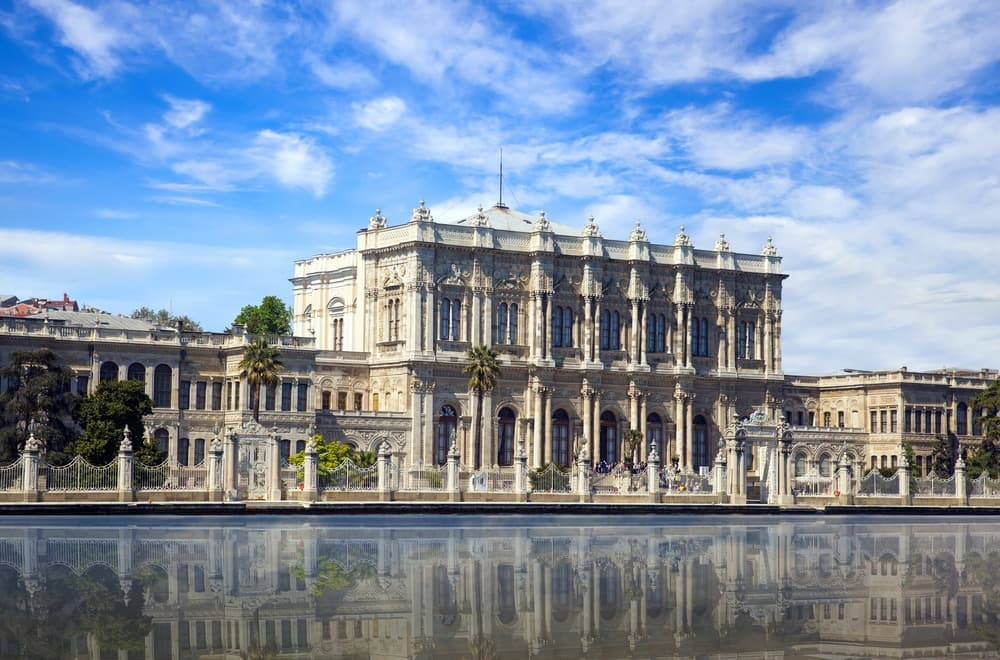
Dolmabahçe Palace
Dolmabahçe Palace
On the Bosphorus in Beşiktaş, Dolmabahçe Palace blends European baroque grandeur with Ottoman décor across 285 rooms. Residence of the last sultans and site of Atatürk's death, it remains a powerful symbol of Turkish history.
On the European shore of the Bosphorus, Dolmabahçe Palace was the official residence of the last Ottoman sultans from 1856 to 1922. Commissioned by Abdülmecid I, it merges European baroque architecture with Ottoman décor across 285 rooms. It was also here that Mustafa Kemal Atatürk died in 1938. The palace remains one of the most representative buildings of the Ottoman Empire's final years.
Practical Information at a Glance
- Admission: paid; two separate tickets available (Harem only or full palace)
- Visit: guided tours mandatory for state rooms; groups accompanied by official guides
- Recommended duration: 1.5 to 2 hours for the entire palace and Harem
- Dress code: no religious restrictions, but smart casual recommended
- Weekly closure: Mondays and Thursdays (standard closure days — verify before your visit)
- Access: Tram T1, Kabataş stop, then short walk along the Bosphorus
What to See
The palace spans approximately 45,000 m² in total area, with a 600-meter façade overlooking the Bosphorus. The state rooms concentrate most of the splendor: marquetry parquet floors, Bohemian crystal and Baccarat chandeliers, gilded coffered ceilings. The Harem, a separate wing, reveals the private quarters of the imperial family.
- Great Ceremonial Hall (Muayede Salonu): the central chandelier weighs approximately 4.5 tonnes and contains over 750 bulbs.
- Crystal staircase: Baccarat crystal and gilded brass railings, a masterpiece of interior circulation.
- Atatürk's chamber: preserved as it was; the palace clocks are stopped at 9:05 a.m., the hour of his death.
- Gardens overlooking the Bosphorus: French-style parterres, fountains and ornate cast-iron railings.
History and Context
The name "Dolmabahçe" means "filled garden": the site was originally a natural bay that was reclaimed in the 17th century. Construction of the present palace began in 1843 under the direction of architects Nikoğos and Sarkis Balyan. Completed in 1856, it replaced the old Topkapi Palace as the sultan's primary residence. Its enormous cost contributed to the Ottoman Empire's debt crisis.
After the Republic was proclaimed in 1923, Atatürk used it as his presidential residence during his stays in Istanbul. His death in this palace on November 10, 1938, made it a site of national remembrance.
Highlights of Your Visit
The Great Ceremonial Hall
At 2,000 m², it is the palace's largest room. The chandelier gifted by Queen Victoria of England dominates the space. The painted dome and columned galleries create distinctive acoustics and lighting.
The Imperial Harem
Accessible with a separate or combined ticket, the Harem includes the quarters of the sultan's mother (Valide Sultan), his wives and concubines. The décor is more intimate, blending late İznik tiles with European furnishings.
Atatürk's Chamber
A modest room compared to the rest of the palace. The clocks stopped at 9:05 a.m. form a powerful symbol of Turkish national mourning, renewed each November 10.
The Bosphorus Façade
Seen from the gardens or from a ferry, the white 600-meter façade reflects the strait's light. The effect is particularly striking in late morning, when sunlight strikes the dressed stone directly.
Photography Tips
Photography is prohibited inside the state rooms and Harem — a rule strictly enforced. Focus your shots on the gardens and the Bosphorus-facing façade. Late morning light (between 10 a.m. and noon) is ideal for the white façade. From a ferry crossing the Bosphorus, you obtain the most complete perspective of the entire building.
Location and Access
The palace is located in the Beşiktaş district on the European shore of the Bosphorus, between Kabataş and Beşiktaş. The T1 tram (Kabataş stop) is the most direct connection from Sultanahmet or Eminönü. Ferries also serve the Beşiktaş pier, a few minutes' walk away. Car access is possible but parking is limited in this densely built area.
The palace is not fully accessible to people with reduced mobility due to numerous historic staircases.
Nearby Attractions
- Topkapi Palace — the other great Ottoman imperial residence, on the Historic Peninsula, accessible by tram.
- Hagia Sophia — former Byzantine basilica reconverted into a mosque, in Sultanahmet.
- Blue Mosque — six-minaret mosque facing Hagia Sophia, in the same historic district.
- Museum of Painting and Sculpture — housed in the Harem wing of Dolmabahçe, collection of 19th–20th century Ottoman and Turkish art.
- Galata Tower — medieval Genoese tower offering panoramic views over the Golden Horn and Bosphorus, accessible by tram from Kabataş.
Frequently asked questions
During peak season (April–October), queues can be long. Purchasing tickets online or through a local agency helps you avoid waiting at the ticket office.
No. Photography is prohibited in interior rooms. It is permitted in the gardens and on the exterior façade.
Spring (April–May) and autumn (September–October) offer pleasant temperatures and moderate crowds. Summer is heavily visited.
Not necessarily. Check ticketing options: a combined ticket covers state rooms and the Harem, while a single ticket may include only one section.
It's possible but ambitious: each palace requires at least 1.5 to 2 hours. Plan a full day or spread visits over two days to fully enjoy both sites.
Access is limited due to numerous historic staircases. Contact the palace beforehand to learn about available accommodations.
Photos
Interested in this visit?
We can include it in your personalised itinerary.