A Night on the Adrar: When the Sahara Whispers
Lying on my mattress, I listen intently to the singular murmur of water flowing above, on the Adrar plateau. This night is, as always, of pure and silent beauty.
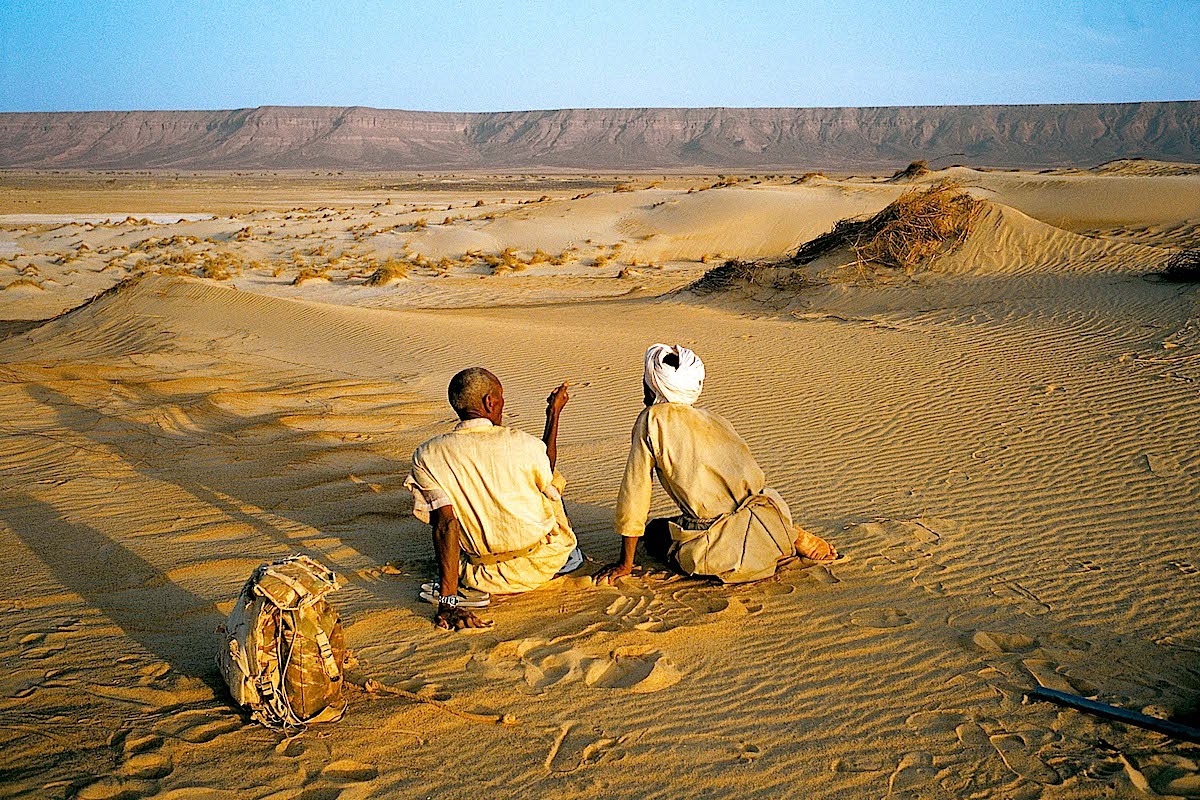
Lying on my mattress, I listen intently to the singular murmur of water flowing above, on the Adrar plateau. This night is, as always, of pure and silent beauty. The Adrar cliff rises, an immense mineral fortress, above me, dominating with majesty the valley — el bâten, in Hassaniya — and this forest of Tazazmout, where acacias, balanites and capers defiantly challenge the aridity of the Mauritanian Sahara.
To the north, the dunes of the Makteir erg obstruct the horizon, motionless in their shifting eternity. Yet, each grain of sand, a tireless traveler, pursues its inexorable journey westward, pushed by the harmattan winds, towards the Atlantic Ocean it may one day reach in some distant future.
In early October, a storm rumbles to the south. Lightning tears across the sky in a thousand flashes, intermittently revealing the silhouettes of distant ridges. Beside me, she sleeps, deeply and peacefully, as if the power of the elements were merely a gentle lullaby.
It rains no doubt on the vast reg of Azilal, north of Wadane. This year, the autumn rains have arrived, generous yet capricious, scattered like hidden treasure. The guelb er Richat, with its perfect circles, shelters between each rîch mysterious lakes that the rain awakens in secret.
The intertropical front slides southward, announcing the approach of winter and cooler air. Here, beneath this boundless sky, all is but eternal recurrence, a slow and patient dance where the desert chains its infinite cycles.
I cherish these intense moments when my spirit takes flight, when the world seems suspended between the raw force of nature and the serenity of these Saharan nights.
Frequently asked questions
The Adrar plateau is a mountainous region in northwestern Mauritania, centered around Atar, its regional capital. It is renowned for its spectacular cliffs, verdant valleys (such as the Tazazmout forest) and its proximity to iconic sites like the guelb er Richat (the Eye of the Sahara) and the Makteir erg.
The guelb er Richat is a circular geological formation visible from space, located in the Adrar region of Mauritania. Its perfect concentric circles, roughly 50 kilometers in diameter, shelter between each ring (called a 'rîch') areas that can form temporary lakes during the autumn rains.
The best time to visit the Adrar is between November and March, when temperatures are milder. Early autumn (October) can offer exceptional natural spectacles with seasonal rains that fill temporary lakes and green the desert, though conditions can be unpredictable.
It is possible to bivouac under the stars in the Adrar desert, either independently with a local guide or as part of an organized tour. Nomadic camps and traditional guesthouses also exist near villages such as Atar or Chinguetti. It is advisable to travel with a guide familiar with the terrain.
The Makteir erg is a vast sand dune field located north of the Adrar plateau in Mauritania. It is one of the great ergs (sand deserts) of the western Sahara, known for its imposing dunes and grand mineral landscape. Sand grains are slowly transported westward there by harmattan winds.